
Introducing the Carbon Clarity Program
Turning Carbon Data into Strategic Insight
Carbon used to live quietly in sustainability reports, usually somewhere between a recycling statistic and a photo of wind turbines at sunset. Those days are, definitively, over.
As regulatory scrutiny intensifies and stakeholders ask harder questions, carbon management has moved well beyond disclosure.
Today it sits squarely within governance, risk management, and strategic decision-making. In many organisations, carbon data is becoming as scrutinised as financial data, which is both logical and, for some, mildly alarming.
At Oxwillow, we see many organisations navigating this shift. Regulators are asking for consistency, investors want credibility, and supply chains increasingly expect transparency. Carbon information, in other words, is no longer just something to publish once a year. It needs to stand up to scrutiny.
So, we went big into carbon, with Tom our in-house carbon expert strengthening our environmental and sustainability initiatives. With professional qualifications in ISO1064-1 and ISO14064-3, he brings expertise in greenhouse gas (GHG) accounting, reporting, verification and validation. As a qualified lead verifier and validator, Tom ensures our carbon and our clients carbon management processes meet internationally recognised standards – supporting accurate emissions reporting and credible climate commitments.
The Carbon Clarity Program was developed by Tom with this reality in mind. Its purpose is simple: to help organisations move from fragmented emissions data to something far more useful; a credible, decision-grade carbon management framework.
Because carbon data is most valuable when it can be used to inform decisions.
Why Carbon Management Is Changing
Across industries, expectations around carbon reporting are evolving rapidly. Regulatory enforcement is tightening. Investors are looking more closely at disclosures. Procurement teams are beginning to examine suppliers’ carbon credentials with the same seriousness they apply to cost or reliability.
At the same time, assurance and verification are becoming standard practice. Carbon accounting is gradually following the path financial reporting travelled decades ago: assumptions must be defensible, data must be traceable, and methodologies must be consistent.
This is sensible, of course. But it also exposes some common challenges.
Many organisations still rely on systems that were designed for broad estimates rather than audit-ready reporting. As scrutiny increases, this can lead to issues such as:
- Uncontrolled Scope 3 assumptions
- Inconsistent year-on-year methodologies
- Weak data traceability
- Unsupported emission factors
- Poorly documented exclusions
None of these are unusual. But left unresolved, they tend to resurface during assurance reviews, often at the least convenient moment.
Carbon accounting, like most forms of accounting, rewards preparation.
The Carbon Clarity Approach
The Carbon Clarity Program is structured around three integrated pillars. Together they help organisations move from uncertainty to credible, decision-grade carbon management.
- Carbon Foundation
Every reliable system begins with a defensible baseline.
Aligned with ISO 14064-1, this stage establishes the fundamentals of emissions management. Organisational and operational boundaries are defined, Scope 1 and Scope 2 emissions are calculated, and material Scope 3 categories are assessed.
A structured greenhouse gas inventory is then built, supported by clear documentation of assumptions, methodologies, and data hierarchies.
The aim is not complexity. It is clarity. The kind that allows someone unfamiliar with the system to understand exactly how the numbers were produced
- Carbon Intelligence
Once the data foundation is in place, carbon information begins to reveal something more interesting: insight.
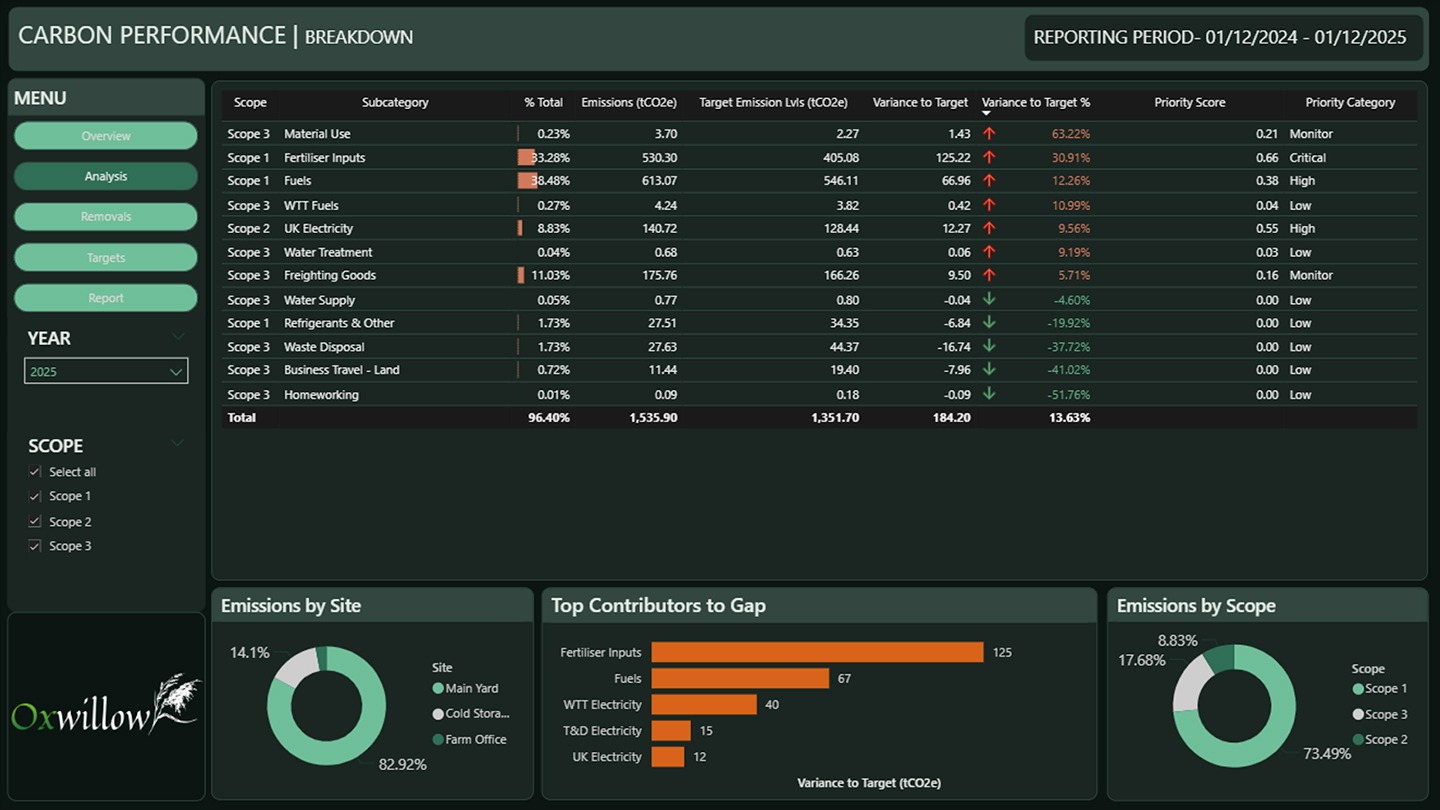
Through an executive carbon dashboard, organisations gain visibility of emissions performance across operations, activities, and business units. Comparable year-on-year reporting helps track progress, while hotspot analysis highlights where reductions are most achievable.
In many cases, the largest opportunities are not hidden, they simply require the right lens to see them clearly.
Carbon data, after all, is most powerful when it informs decisions rather than simply documenting them.
- Assurance Readiness
Verification is increasingly becoming part of the carbon landscape. Preparing for it early tends to make the process considerably smoother.
Designed in line with ISO 14064-3 principles, this stage focuses on preparing organisations for independent assurance. It includes:
- Gap analysis against verification expectations
- Evidence and traceability testing
- Risk reviews for material misstatements
- Strengthening internal carbon governance controls
The objective is straightforward: reduce audit disruption and increase confidence in reported carbon data.
And ideally avoid the late-night scramble for missing spreadsheets that tends to accompany first-time verification.
What the Program Delivers
Organisations participating in the Carbon Clarity Program receive:
- A complete carbon baseline and greenhouse gas inventory
- A quarterly-updated carbon intelligence dashboard
- An assurance readiness assessment
- A target-setting workshop
- A reduction roadmap highlighting the ten most impactful interventions
- Twelve months of advisory support with quarterly reviews
- Guidance for future verification processes
In short, a carbon management system designed not just to report emissions, but to manage them.
Who the Program Is For
The program is particularly relevant for organisations that are:
- Preparing for regulatory frameworks such as CSRD
- Anticipating carbon verification or assurance requirements
- Experiencing increasing supply chain pressure to disclose emissions
- Integrating carbon oversight into executive governance
Or, put simply, organisations recognising that carbon reporting is gradually becoming part of normal business accountability.
A Different Approach to Carbon Management
Traditional carbon footprint exercises often result in a single report, useful for disclosure but rarely integrated into decision-making.
Our approach focuses instead on robust baselining, defensible methodologies, and insights that improve over time. The intention is to build a system that evolves with the organisation rather than restarting the process each year.
Because carbon reporting is no longer just a sustainability exercise. Increasingly, it is a governance capability.
And like most governance capabilities, it works best when it is clear, consistent, and quietly reliable.
The Carbon Clarity Program was designed to help organisations reach that point.